Uganda 



Facts
Background: The colonial boundaries created by Britain to delimit Uganda grouped together a wide range of ethnic groups with different political systems and cultures. These differences prevented the establishment of a working political community after independence was achieved in 1962. The dictatorial regime of Idi AMIN (1971-79) was responsible for the deaths of some 300,000 opponents; guerrilla war and human rights abuses under Milton OBOTE (1980-85) claimed at least another 100,000 lives. The rule of Yoweri MUSEVENI since 1986 has brought relative stability and economic growth to Uganda. During the 1990s, the government promulgated non-party presidential and legislative elections.
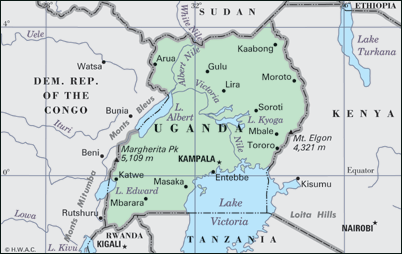
Location: Eastern Africa, west of Kenya, east of the Democratic Republic of the Congo
Area land: 197,100 sq km
Area water: 43,938 sq km
Coastline: 0 km (landlocked)
Country name conventional long form: Republic of Uganda
Country name conventional short form: Uganda
Country name former: Republic of Uganda
Population: 34,612,250
Age structure: 0-14 years: 49.9% (male 8,692,239/female 8,564,571); 15-64 years: 48.1% (male 8,383,548/female 8,255,473); 65 years and over: 2.1% (male 291,602/female 424,817) (2011 est.);
Population growth rate: 3.576% (2011 est.)
Birth rate: 47.49 births/1,000 population (2011 est.)
Death rate: 11.71 deaths/1,000 population (July 2011 est.)
Net migration rate: -0.02 migrant(s)/1,000 population (2011 est.)
Sex ratio: at birth: 1.03 male(s)/female; under 15 years: 1.01 male(s)/female; 15-64 years: 1.01 male(s)/female; 65 years and over: 0.7 male(s)/female; total population: 1.01 male(s)/female (2011 est.);
Infant mortality rate: total: 62.47 deaths/1,000 live births; male: 66.05 deaths/1,000 live births; female: 58.77 deaths/1,000 live births (2011 est.);
Life expectancy at birth: total population: 53.24 years; male: 52.17 years; female: 54.33 years (2011 est.);
Total fertility rate: 6.69 children born/woman (2011 est.);
HIV/AIDS - adult prevalence rate: 6.5% (2009 est.);
HIV/AIDS - people living with HIV/AIDS: 1.2 million (2009 est.);
HIV/AIDS - deaths: 64,000 (2009 est.);
Nationality: noun: Ugandan(s); adjective: Ugandan;
Ethnic groups: Baganda 16.9%, Banyakole 9.5%, Basoga 8.4%, Bakiga 6.9%, Iteso 6.4%, Langi 6.1%, Acholi 4.7%, Bagisu 4.6%, Lugbara 4.2%, Bunyoro 2.7%, other 29.6% (2002 census);
Religions: Roman Catholic 41.9%, Protestant 42% (Anglican 35.9%, Pentecostal 4.6%, Seventh Day Adventist 1.5%), Muslim 12.1%, other 3.1%, none 0.9% (2002 census);
Languages: English (official national language, taught in grade schools, used in courts of law and by most newspapers and some radio broadcasts), Ganda or Luganda (most widely used of the Niger-Congo languages, preferred for native language publications in the capital and may be taught in school), other Niger-Congo languages, Nilo-Saharan languages, Swahili, Arabic;
Literacy: definition: age 15 and over can read and write; total population: 66.8%; male: 76.8%; female: 57.7% (2002 census);
GDP (purchasing power parity): $41.7 billion (2010 est.); $39.41 billion (2009 est.); $36.76 billion (2008 est.);
GDP (official exchange rate): $17.12 billion (2010 est.);
GDP - real growth rate: 5.8% (2010 est.); 7.2% (2009 est.); 8.7% (2008 est.);
GDP - per capita (PPP): $1,200 (2010 est.); $1,200 (2009 est.); $1,200 (2008 est.);
GDP - composition by sector: agriculture: 23.6%; industry: 24.5%; services: 51.9% (2010 est.);
Population below poverty line: 35% (2001 est.);
Household income or consumption by percentage share: lowest 10%: 2.6%; highest 10%: 34.1% (2005);
Labor force: 15.51 million (2010 est.);
Labor force - by occupation: agriculture: 82%; industry: 5%; services: 13% (1999 est.);
Unemployment rate: NA%;
Budget: revenues: $2.457 billion; expenditures: $2.938 billion (2010 est.);
Industries: sugar, brewing, tobacco, cotton textiles; cement, steel production;
Industrial production growth rate: 6% (2010 est.);
Electricity - production: 2.256 billion kWh (2007 est.);
Electricity - consumption: 2.068 billion kWh (2007 est.);
Electricity - exports: 30 million kWh (2007);
Electricity - imports: 0 kWh (2008 est.);
Press
Bukedde
(Local Language Daily), Kampala
http://www.bukedde.co.ug/
Daily Monitor
(Independent), Kampala
http://www.monitor.co.ug/
New Vision, The
(Government-owned, Independent), Kampala
http://www.newvision.co.ug/
The Observer
(English-language), Kampala
http://www.observer.ug/
Uganda in the News

Displaying 17 to 20 of 20 items.
Shock, but No Awe
African press reaction to the war in Iraq followed the continent's strong antiwar stance. World Press Review associate editor Sarah Coleman surveys the regional press.
A Poet Among Journalists
Kapuscinski, who was born in Poland in 1932, has spent his career chronicling political shifts in the Third World.
Troubled Election
Though Uganda's incumbent President Yoweri Museveni won 69 percent of the vote, allegations of vote-fixing and intimidation tainted his victory.
Cult of the Dead
As the death toll among members of a little-known Ugandan religious cult rose beyond 1,000, press reports on the group’s history shed some light on the origins of the tragedy.