South Africa 



Facts
Background: Dutch traders landed at the southern tip of modern day South Africa in 1652 and established a stopover point on the spice route between the Netherlands and the Far East, founding the city of Cape Town. After the British seized the Cape of Good Hope area in 1806, many of the Dutch settlers (the Boers) trekked north to found their own republics. The discovery of diamonds (1867) and gold (1886) spurred wealth and immigration and intensified the subjugation of the native inhabitants. The Boers resisted British encroachments but were defeated in the Boer War (1899-1902); however, the British and the Afrikaners, as the Boers became known, ruled together beginning in 1910 under the Union of South Africa, which became a republic in 1961 after a whites-only referendum. In 1948, the National Party was voted into power and instituted a policy of apartheid - the separate development of the races - which favored the white minority at the expense of the black majority. The African National Congress (ANC) led the opposition to apartheid and many top ANC leaders, such as Nelson MANDELA, spent decades in South Africa's prisons. Internal protests and insurgency, as well as boycotts by some Western nations and institutions, led to the regime's eventual willingness to negotiate a peaceful transition to majority rule. The first multi-racial elections in 1994 brought an end to apartheid and ushered in majority rule under an ANC-led government. South Africa since then has struggled to address apartheid-era imbalances in decent housing, education, and health care. ANC infighting, which has grown in recent years, came to a head in September 2008 when President Thabo MBEKI resigned, and Kgalema MOTLANTHE, the party's General-Secretary, succeeded him as interim president. Jacob ZUMA became president after the ANC won general elections in April 2009. In January 2011, South Africa assumed a nonpermanent seat on the UN Security Council for the 2011-12 term.
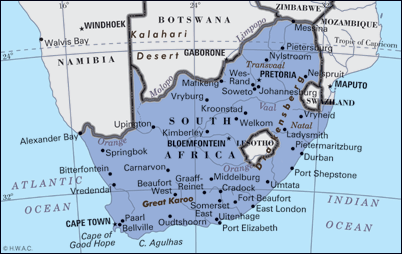
Location: Southern Africa, at the southern tip of the continent of Africa
Area land: 1,214,470 sq km
Area water: 4,620 sq km
Coastline: 2,798 km
Country name conventional long form: Republic of South Africa
Country name conventional short form: South Africa
Country name former: Union of South Africa
Population: 49,004,031
Age structure: 0-14 years: 28.5% (male 6,998,726/female 6,959,542); 15-64 years: 65.8% (male 16,287,314/female 15,972,046); 65 years and over: 5.7% (male 1,125,709/female 1,660,694) (2011 est.);
Population growth rate: -0.38% (2011 est.)
Birth rate: 19.48 births/1,000 population (2011 est.)
Death rate: 17.09 deaths/1,000 population (July 2011 est.)
Net migration rate: -6.19 migrant(s)/1,000 population
Sex ratio: at birth: 1.02 male(s)/female; under 15 years: 1 male(s)/female; 15-64 years: 1.02 male(s)/female; 65 years and over: 0.68 male(s)/female; total population: 0.99 male(s)/female (2011 est.);
Infant mortality rate: total: 43.2 deaths/1,000 live births; male: 47.19 deaths/1,000 live births; female: 39.14 deaths/1,000 live births (2011 est.);
Life expectancy at birth: total population: 49.33 years; male: 50.24 years; female: 48.39 years (2011 est.);
Total fertility rate: 2.3 children born/woman (2011 est.);
HIV/AIDS - adult prevalence rate: 17.8% (2009 est.);
HIV/AIDS - people living with HIV/AIDS: 5.6 million (2009 est.);
HIV/AIDS - deaths: 310,000 (2009 est.);
Nationality: noun: South African(s); adjective: South African;
Ethnic groups: black African 79%, white 9.6%, colored 8.9%, Indian/Asian 2.5% (2001 census);
Religions: Zion Christian 11.1%, Pentecostal/Charismatic 8.2%, Catholic 7.1%, Methodist 6.8%, Dutch Reformed 6.7%, Anglican 3.8%, Muslim 1.5%, other Christian 36%, other 2.3%, unspecified 1.4%, none 15.1% (2001 census);
Languages: IsiZulu (official) 23.8%, IsiXhosa (official) 17.6%, Afrikaans (official) 13.3%, Sepedi (offcial) 9.4%, English (official) 8.2%, Setswana (official) 8.2%, Sesotho (official) 7.9%, Xitsonga (official) 4.4%, other 7.2%, isiNdebele (official), Tshivenda (official), siSwati (official) (2001 census);
Literacy: definition: age 15 and over can read and write; total population: 86.4%; male: 87%; female: 85.7% (2003 est.);
GDP (purchasing power parity): $527.5 billion (2010 est.); $512.2 billion (2009 est.); $521.6 billion (2008 est.);
GDP (official exchange rate): $354.4 billion (2010 est.);
GDP - real growth rate: 3% (2010 est.); -1.8% (2009 est.); 3.7% (2008 est.);
GDP - per capita (PPP): $10,700 (2010 est.); $10,400 (2009 est.); $10,700 (2008 est.);
GDP - composition by sector: agriculture: 3%; industry: 31.2%; services: 65.8% (2010 est.);
Population below poverty line: 50% (2000 est.);
Household income or consumption by percentage share: lowest 10%: 1.3%; highest 10%: 44.7% (2000);
Labor force: 17.32 million economically active (2010 est.);
Labor force - by occupation: agriculture: 9%; industry: 26%; services: 65% (2007 est.);
Unemployment rate: 23.3% (2010 est.); 24% (2009 est.);
Budget: revenues: $103.1 billion; expenditures: $126.2 billion (2010 est.);
Industries: mining (world's largest producer of platinum, gold, chromium), automobile assembly, metalworking, machinery, textiles, iron and steel, chemicals, fertilizer, foodstuffs, commercial ship repair;
Industrial production growth rate: 3% (2010 est.);
Electricity - production: 240.3 billion kWh (2007 est.);
Electricity - consumption: 215.1 billion kWh (2007 est.);
Electricity - exports: 14.16 billion kWh (2008 est.);
Electricity - imports: 10.57 billion kWh (2008 est.);
Press

South Africa in the News

Displaying 1 to 4 of 45 items.
U.S.-Africa Summit: Partnership Opportunities
The upcoming summit between U.S. and African leaders is likely to make progress on a number of investment, development and security issues.
Nelson Mandela: The Global Icon Goes Home
Mandela's work to end apartheid in South Africa and fight for peace and equality throughout the world has left an indelible imprint on the global community.
Blood Diamonds
Nine years after the Kimberley Process was formed to stop the trade in conflict diamonds and ensure that diamond purchases were not funding violence, the KP has refused to evolve and address the clear links between diamonds, violence and tyranny.
Development Challenges for Africa in 2012
With economic malaise in the West and a growing population of young people at home, Africa faces significant challenges and opportunities in the coming year.