Indonesia 

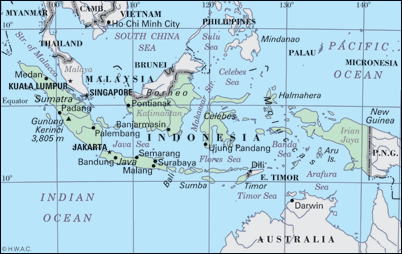


Facts
Background: The Dutch began to colonize Indonesia in the early 17th century; Japan occupied the islands from 1942 to 1945. Indonesia declared its independence after Japan's surrender, but it required four years of intermittent negotiations, recurring hostilities, and UN mediation before the Netherlands agreed to transfer sovereignty in 1949. Free and fair legislative elections took place in 1999 after decades of repressive rule. Indonesia is now the world's third most populous democracy, the world's largest archipelagic state, and home to the world's largest Muslim population. Current issues include: alleviating poverty, improving education, preventing terrorism, consolidating democracy after four decades of authoritarianism, implementing economic and financial reforms, stemming corruption, holding the military and police accountable for human rights violations, addressing climate change, and controlling infectious diseases, particularly those of global and regional importance. In 2005, Indonesia reached a historic peace agreement with armed separatists in Aceh, which led to democratic elections in Aceh in December 2006. Indonesia continues to face low intensity armed resistance by the separatist Free Papua Movement.
Location: Southeastern Asia, archipelago between the Indian Ocean and the Pacific Ocean
Area land: 1,811,569 sq km
Area water: 93,000 sq km
Coastline: 54,716 km
Country name conventional long form: Republic of Indonesia
Country name conventional short form: Indonesia
Country name former: Netherlands East Indies, Dutch East Indies
Population: 245,613,043 (July 2011 est.)
Age structure: 0-14 years: 27.3% (male 34,165,213/female 32,978,841); 15-64 years: 66.5% (male 82,104,636/female 81,263,055); 65 years and over: 6.1% (male 6,654,695/female 8,446,603) (2011 est.);
Population growth rate: 1.069% (2011 est.)
Birth rate: 18.1 births/1,000 population (2011 est.)
Death rate: 6.26 deaths/1,000 population (July 2011 est.)
Net migration rate: -1.15 migrant(s)/1,000 population (2011 est.)
Sex ratio: at birth: 1.05 male(s)/female; under 15 years: 1.04 male(s)/female; 15-64 years: 1.01 male(s)/female; 65 years and over: 0.79 male(s)/female; total population: 1 male(s)/female (2011 est.);
Infant mortality rate: total: 27.95 deaths/1,000 live births; male: 32.63 deaths/1,000 live births; female: 23.03 deaths/1,000 live births (2011 est.);
Life expectancy at birth: total population: 71.33 years; male: 68.8 years; female: 73.99 years (2011 est.);
Total fertility rate: 2.25 children born/woman (2011 est.);
HIV/AIDS - adult prevalence rate: 0.2% (2009 est.);
HIV/AIDS - people living with HIV/AIDS: 310,000 (2009 est.);
HIV/AIDS - deaths: 8,300 (2009 est.);
Nationality: noun: Indonesian(s); adjective: Indonesian;
Ethnic groups: Javanese 40.6%, Sundanese 15%, Madurese 3.3%, Minangkabau 2.7%, Betawi 2.4%, Bugis 2.4%, Banten 2%, Banjar 1.7%, other or unspecified 29.9% (2000 census);
Religions: Muslim 86.1%, Protestant 5.7%, Roman Catholic 3%, Hindu 1.8%, other or unspecified 3.4% (2000 census);
Languages: Bahasa Indonesia (official, modified form of Malay), English, Dutch, local dialects (the most widely spoken of which is Javanese);
Literacy: definition: age 15 and over can read and write; total population: 90.4%; male: 94%; female: 86.8% (2004 est.);
GDP (purchasing power parity): $1.033 trillion (2010 est.); $974.6 billion (2009 est.); $932.6 billion (2008 est.);
GDP (official exchange rate): $695.1 billion (2010 est.);
GDP - real growth rate: 6% (2010 est.); 4.5% (2009 est.); 6% (2008 est.);
GDP - per capita (PPP): $4,300 (2010 est.); $4,100 (2009 est.); $3,900 (2008 est.);
GDP - composition by sector: agriculture: 16.5%; industry: 46.4%; services: 37.1% (3rd quarter, 2010 est.);
Population below poverty line: 13.33% (2010);
Household income or consumption by percentage share: lowest 10%: 3%; highest 10%: 32.3% (2006);
Labor force: 116.5 million (2010 est.);
Labor force - by occupation: agriculture: 38.3%; industry: 12.8%; services: 48.9% (2010 est.);
Unemployment rate: 7.1% (2010 est.); 7.9% (2009 est.);
Budget: revenues: $119.5 billion; expenditures: $132.9 billion (2011 est.);
Industries: petroleum and natural gas, textiles, apparel, footwear, mining, cement, chemical fertilizers, plywood, rubber, food, tourism;
Industrial production growth rate: 3.6% (2010 est.);
Electricity - production: 129 billion kWh (2008 est.);
Electricity - consumption: 119.3 billion kWh (2007 est.);
Electricity - exports: 0 kWh (2009 est.);
Electricity - imports: 0 kWh (2009 est.);
Press
Bisnis Indonesia
(Business-oriented, independent), Jakarta
http://www.bisnis.com/
Jakarta Post, The
(Independent, English-language), Jakarta
http://www.thejakartapost.com/
Kompas
(Independent), Jakarta
http://www.kompas.com
Republika
(Islamist), Jakarta
http://www.republika.co.id/
Waspada
(Independent daily), Medan
http://www.waspada.co.id/
Indonesia in the News


Displaying 33 to 36 of 55 items.
Indonesia: Anguish in Aceh
Rachel S. Taylor reviews Indonesian press coverage of the renewed hostilities in Aceh.
Aceh's History of No Surrender
Sian Powell, Aceh correspondent for Sydney's conservative Australian, traces the historical roots of the current conflict between the Indonesian military and separatist rebels in Aceh.
An Ironic Message of Tolerance
In an article for The Jakarta Post, Muhammad Qodari responds to U.S. 'public diplomacy' films depicting Muslim life in America by saying Americans need to learn from them as much as their intended audience overseas.
Indonesia and Australia: Bali's Blackest Day
World Press Review associate editor Rachel S. Taylor reviews Indonesian and Australian press coverage of the Bali bombing and its aftermath.