Egypt 



Facts
Background: The regularity and richness of the annual Nile River flood, coupled with semi-isolation provided by deserts to the east and west, allowed for the development of one of the world's great civilizations. A unified kingdom arose circa 3200 B.C., and a series of dynasties ruled in Egypt for the next three millennia. The last native dynasty fell to the Persians in 341 B.C., who in turn were replaced by the Greeks, Romans, and Byzantines. It was the Arabs who introduced Islam and the Arabic language in the 7th century and who ruled for the next six centuries. A local military caste, the Mamluks took control about 1250 and continued to govern after the conquest of Egypt by the Ottoman Turks in 1517. Following the completion of the Suez Canal in 1869, Egypt became an important world transportation hub, but also fell heavily into debt. Ostensibly to protect its investments, Britain seized control of Egypt's government in 1882, but nominal allegiance to the Ottoman Empire continued until 1914. Partially independent from the UK in 1922, Egypt acquired full sovereignty with the overthrow of the British-backed monarchy in 1952. The completion of the Aswan High Dam in 1971 and the resultant Lake Nasser have altered the time-honored place of the Nile River in the agriculture and ecology of Egypt. A rapidly growing population (the largest in the Arab world), limited arable land, and dependence on the Nile all continue to overtax resources and stress society. The government has struggled to meet the demands of Egypt's growing population through economic reform and massive investment in communications and physical infrastructure.
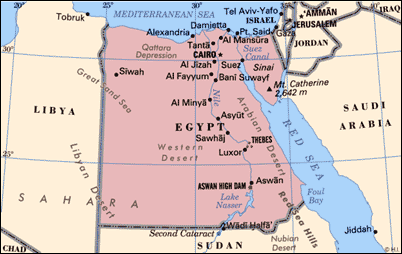
Location: Northern Africa, bordering the Mediterranean Sea, between Libya and the Gaza Strip, and the Red Sea north of Sudan, and includes the Asian Sinai Peninsula
Area land: 995,450 sq km
Area water: 6,000 sq km
Coastline: 2,450 km
Country name conventional long form: Arab Republic of Egypt
Country name conventional short form: Egypt
Country name former: United Arab Republic (with Syria)
Population: 82,079,636 (July 2011 est.)
Age structure: 0-14 years: 32.7% (male 13,725,282/female 13,112,157); 15-64 years: 62.8% (male 26,187,921/female 25,353,947); 65 years and over: 4.5% (male 1,669,313/female 2,031,016) (2011 est.);
Population growth rate: 1.96% (2011 est.)
Birth rate: 24.63 births/1,000 population (2011 est.)
Death rate: 4.82 deaths/1,000 population (July 2011 est.)
Net migration rate: -0.21 migrant(s)/1,000 population (2011 est.)
Sex ratio: at birth: 1.05 male(s)/female; under 15 years: 1.05 male(s)/female; 15-64 years: 1.03 male(s)/female; 65 years and over: 0.83 male(s)/female; total population: 1.03 male(s)/female (2011 est.);
Infant mortality rate: total: 25.2 deaths/1,000 live births; male: 26.8 deaths/1,000 live births; female: 23.52 deaths/1,000 live births (2011 est.);
Life expectancy at birth: total population: 72.66 years; male: 70.07 years; female: 75.38 years (2011 est.);
Total fertility rate: 2.97 children born/woman (2011 est.);
HIV/AIDS - adult prevalence rate: less than 0.1% (2009 est.);
HIV/AIDS - people living with HIV/AIDS: 11,000 (2009 est.);
HIV/AIDS - deaths: fewer than 500 (2009 est.);
Nationality: noun: Egyptian(s); adjective: Egyptian;
Ethnic groups: Egyptian 99.6%, other 0.4% (2006 census);
Religions: Muslim (mostly Sunni) 90%, Coptic 9%, other Christian 1%;
Languages: Arabic (official), English and French widely understood by educated classes;
Literacy: definition: age 15 and over can read and write; total population: 71.4%; male: 83%; female: 59.4% (2005 est.);
GDP (purchasing power parity): $500.9 billion (2010 est.); $475.7 billion (2009 est.); $454.8 billion (2008 est.);
GDP (official exchange rate): $216.8 billion (2010 est.);
GDP - real growth rate: 5.3% (2010 est.); 4.6% (2009 est.); 7.2% (2008 est.);
GDP - per capita (PPP): $6,200 (2010 est.); $6,000 (2009 est.); $5,900 (2008 est.);
GDP - composition by sector: agriculture: 13.5%; industry: 37.9%; services: 48.6% (2010 est.);
Population below poverty line: 20% (2005 est.);
Household income or consumption by percentage share: lowest 10%: 3.9%; highest 10%: 27.6% (2005);
Labor force: 26.1 million (2010 est.);
Labor force - by occupation: agriculture: 32%; industry: 17%; services: 51% (2001 est.);
Unemployment rate: 9.7% (2010 est.); 9.4% (2009 est.);
Budget: revenues: $46.82 billion; expenditures: $64.19 billion (2010 est.);
Industries: textiles, food processing, tourism, chemicals, pharmaceuticals, hydrocarbons, construction, cement, metals, light manufactures;
Industrial production growth rate: 5.5% (2010 est.);
Electricity - production: 118.4 billion kWh (2007 est.);
Electricity - consumption: 104.1 billion kWh (2007 est.);
Electricity - exports: 814 million kWh (2007 est.);
Electricity - imports: 251 million kWh (2007 est.);
Press
Al Dostor
(Opposition),
http://www.dostor.org/
Al-Ahram
(Semi-official), Cairo
http://www.ahram.org.eg
Arab Finance
(Financial, bi-lingual), Cairo
http://www.arabfinance.com/
Egypt Today
(English-language), Cairo
http://www.egypttoday.com/
El Fagr
(Independent newsweekly), Cairo
http://elfagr.org/
Elaph
(Independent), Cairo
http://www.elaph.com/
Egypt in the News


Displaying 21 to 24 of 76 items.
The Muslim Brotherhood: Who Are They?
Recent events in Tunisia and Egypt have suddenly brought to light this organization that few Americans have ever heard of, the Muslim Brotherhood.
Egypt Has Long Deserved Better
To those who have lived with Egyptians—many of whom sleep on a dirt floor—these proud, patient, rightfully angry people are well overdue to catch a break.
Update from Egypt: Via Bloggers
Civil unrest and the vicious government response in Egypt
Egypt's President Should Dissolve Parliament
Egypt's rigged elections, coupled with brutality by government security forces, have caused human rights organizations to call for drastic change.