 |
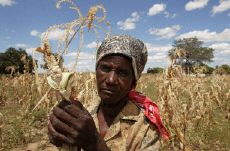
| Miriam Mushindibaba, of Chemhere, Zimbabwe, photographed in her drought-stricken field of corn, March 23, 2002 (Photo: AFP). |
The New Partnership for Africa’s Development (NEPAD) is a concept that has sparked widespread political and intellectual discourse not only in Zimbabwe but also in the region and in the diaspora.
Contentious views have been expressed: Proponents have lauded NEPAD as an initiative that will deliver Africa from its current state of abject poverty, while opponents have dismissed it as another ploy by the West to perpetuate its economic and political siege over Africa. They say it has been modeled along the same lines as the “failed” policies of the international finance institutions, the World Bank and the International Monetary Fund (IMF) being blamed as the major culprits in this regard.
NEPAD is a plan of action that was initiated by African leaders with the aim of firmly putting Africa on the road to economic recovery. It recognizes the continent’s urgent need to eradicate poverty and reduce the inequalities in lifestyles between Africa and the rest of the world.
It is modeled around particular initiatives that are—inter alia—building peace on the war-ravaged continent, establishing democratic governance and respect for human rights as core values that shape the political culture of African governments, instituting economic and corporate governance as confidence-building measures which will lure investment to the continent, and working to open markets for African products in the global economy, among other issues.
The African leaders at the forefront of NEPAD’s creation are the likes of Thabo Mbeki of South Africa, Olusegun Obasanjo of Nigeria, and Abdoulaye Wade of Senegal. Those who are hopeful about solving Africa’s governance crisis have placed their hope in these leaders as Africa grapples with poverty and HIV/AIDS.
Notable critics of the plan on the African continent have included old horses like Muammar Qaddafi of Libya, Zimbabwe’s Robert Mugabe, and Sam Nujoma of Namibia, among others. This is the crop of leaders that has been viewed as the true epitome of African autocrats, whose ideals NEPAD will have to fight and dispense with for it to be workable.
It is my contention that NEPAD is a brilliant initiative that, if it were to be implemented, would be the panacea to Africa’s problems. But there are plenty of African initiatives that were launched with very brilliant ideas and plausible programs of action, but which were never implemented.
The major problem is that one of the basic preconditions for NEPAD’s recovery plan is that democratic governance and respect for human rights must be internalized in African regimes. Many African leaders today are preoccupied with maintaining their grip on political power and do not see the benefits of governing democratically. They develop paranoia when they hear of the concepts of democracy and good governance. They rush to dismiss these concepts as neocolonial maneuvers, and—in the case of Zimbabwe—the British become the culprits.
It is no coincidence that those African leaders who have for long refused to embrace democratic values are the ones refusing to embrace NEPAD. They have vainly tried to make it sound as if NEPAD is an idea of the Americans and the British when in fact it is the brainchild of Africans.
Witness Qaddafi’s blubbering at the official launch of the African Union in Durban and how, in that broken English of his, he tried to shoot down NEPAD, much to the excitement of democratically challenged despots like Mugabe and Nujoma.
Another factor threatening NEPAD’s implementation is the tacit African “brotherhood” which exists among the continent’s leaders, making them blind to the follies of their fellow leaders. Zimbabwe stands out as a classic example of this. NEPAD will not work if proponents like Mbeki fail to flex their muscle to censure fellow leaders like Mugabe in their wayward behavior.
Mbeki has failed to deal with the situation in Zimbabwe in an honest manner, and as the country plunges deeper into a political and humanitarian crisis, the deafening silence from the rest of the continent only confirms the suspicion that the other African leaders are endorsing Mugabe’s devastation of the once beautiful country.
They were silent when opposition members in Zimbabwe were butchered in the run-up to the 2000 general election and the 2002 presidential poll. They were silent when Mugabe embarked on his chaotic land-grab exercise, which has plunged the country into starvation.
They were silent when draconian laws like the Access to Information and Protection of Privacy Act and the Public Order and Security Act were enacted. These two pieces of legislation have made it virtually impossible for voices of dissent to be heard in Zimbabwe. NEPAD will flop if African leaders fail to deal with such glaring violations of human rights.
Even at the launch of the African Union, the African leaders demonstrated their “unholy alliance” of autocrats when they failed to recognize Marc Ravalomanana as the legitimate leader of Madagascar and instead threw their weight behind the disgraced Didier Ratsiraka. Such acts of giving unconditional support to illegitimate regimes will derail the democratization process that is a crucial precursor to luring investment and thereby eradicating poverty on the African continent.
Another crucial test that NEPAD will have to stand is that of the legitimacy—and hence, acceptability—of the process itself. For any process to be accepted by the people, they have to be involved in its formulation. NEPAD fails in this respect. There was no consultation at the grass-roots level, and NEPAD is silent on the role of civic society in its plan. Economic and corporate governance as enshrined in NEPAD will not be achieved without the involvement of civil society.
One other assumption that has underpinned the NEPAD program is that the industrialized countries—maybe through their supervising body, the G-8—will make available sufficient funds to support the implementation of NEPAD’s initiatives. But this will not happen, because of the continuous decline of public financial aid that these countries are allocating to Africa and the rest of the developing world.
Moreover, the time frame that the proponents of NEPAD have in mind might not be realistic. Given the heterogeneity of the region’s economic and cultural mosaic, it will probably take a decade before there can be specific projects that are in tandem with Africa’s development needs. It will also take time for these projects to be sold to financing institutions like the IMF and the World Bank, which are crucial to the success of the program.
In any case, the richest nations which control these financing institutions have not demonstrated unwavering support for the initiative. On June 26-27, 2002, at the G-8 meeting in the remote town of Kananaskis, Canada, very little time was given to discussing NEPAD; the rich nations promised to do so next year. In the meanwhile, Africa plunges deeper into poverty.

