
Viewpoints
 |
|
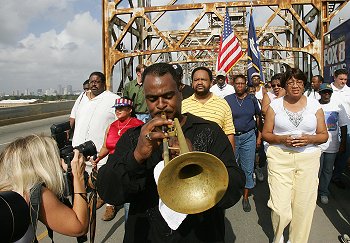
Trumpet player Marlon Jordan plays his horn during a memorial in the Lower Ninth Ward of New Orleans to commemorate the victims of Hurricane Katrina on the first anniversary of the storm. (Photo: Robyn Beck / AFP-Getty Images) |
"The U.S. is marking the first anniversary of Hurricane Katrina, which killed more than 1,800 people and left devastation in its wake."
The U.K.'s ITV (Aug. 29).
The international press has extensively covered both the hurricane and its aftermath. France's International Herald Tribune (Aug. 28) carried an article written by novelist Sheila Bosworth which provided a graphic description of the ensuing chaos in the wake of the storm: "It was still dark, at 4:30 a.m. on Aug. 29, when Hurricane Katrina skipped off course and made landfall downriver from New Orleans at Buras, Louisiana, as a Category 4 storm. … Cars were as desperately coveted as the 'letters of transit' in 'Casablanca' — the only means of escape, of immeasurable worth, and therefore as dangerous to possess as not to possess."
"Hurricane Katrina was the agent not only of one of the greatest natural disasters in American history, but of a diaspora as well. The storm scattered the surviving population of New Orleans across the continent; one group of New Orleans evacuees who disembarked from a rescue plane in a Western state thought the mountains they saw in the distance were a painted cardboard backdrop. Hurricane Katrina denied us the usual consolation granted to those who have shared a catastrophe: the solace of 'we're all in this together.' We were all in it together, only nobody knew where everybody else was."
In the year since the devastating event, the most contentious issue surrounding the reconstruction of the city involves the issue of race. As the U.K.'s BBC (Aug. 25) reported: "New Orleans is in a struggle over how it will be rebuilt — and whether the poor and working-class African-Americans who made up a large part of its pre-flood population will ever be able to return. Race, class, money and power are inextricably linked in the U.S., and the flooding of New Orleans is proving a textbook example of how they intersect. … 'In the wake of the flood, a small group of powerful business leaders and developers — the old blue-blood elite — took it upon themselves to plan the city into the next 20-30 years,' said Lance Hill, executive director of the Southern Institute for Education and Research at Tulane University."
"The problem was that 'virtually no African-Americans' had returned to the city when those plans were being formed, said Mr. Hill, who described himself as a white liberal. There were proposals not to rebuild historically black neighborhoods, which alarmed African-Americans, he said. 'African-Americans who were displaced became deeply suspicious that their homes were going to be bulldozed, their jobs taken away and their hospitals closed. There was a general fear that they were being locked out of the city.'"
"Mr. Hill said he believes the intention was to exclude poor people. But because the city had been racially segregated for generations, the practical effect was to exclude blacks. 'If you want to eliminate a high concentration of poor African-Americans by eliminating a neighborhood, you also eliminate working-class, middle-class, even wealthy blacks,' he said. 'Class became race in New Orleans.'"
In an article titled, "Heart of Orleans still broken," Scotland's The Scotsman (Aug. 26) told the story of one area resident: "Peter Badie, 81, lived in the same house in New Orleans for more than 50 years. But these days, like so many others from this catastrophe-crippled city, he has had trouble finding the road home. The jazz musician, who played with greats such as Dizzy Gillespie and Sam Cooke, gazed across the wrecked street he once knew like the back of his hand and said: 'That's 52 years I've been here and I don't know my own neighborhood any more.'"
"As the city prepared to mark the first anniversary of Hurricane Katrina and the flood that swallowed 80 percent of its expanse, less than half of the 450,000 people of Orleans parish — which forms the core of the city — have returned. Many have made new lives in states such as Texas, Georgia, Alabama and Arkansas, unable or unwilling to face the logistical, financial and emotional hurdles associated with trying to rebuild here."
"The Lower Ninth Ward, a majority black neighborhood where Mr. Badie's bungalow was submerged for weeks and is now condemned, has the air of an abandoned Wild West town. There are houses full of debris and river sludge, pylons leaning at odd angles, power lines dangling, mud-stained sofas, mattresses, clothes and toys lying wherever the flood washed them. There is no electricity, mains water, phone service or schools. The only sounds are the buzz of crickets and the occasional crunch of debris being cleared by contractors. There is little traffic to halt at junction 'Stop' signs. The only green shoots of recovery are the weeds snaking through the remains of this formerly energetic community."
"On the other side of the city, Lake View — a more affluent, majority white neighborhood which suffered flooding on a similar scale — is also still devastated. But there are pockets of recovery: new houses have sprung up, fronted by neatly-mowed lawns and flowerbeds, and on every street there is activity - roofs being fixed, debris being hauled out, demolition work under way. 'Oh yes, Lake View is back isn't it?' shouted Mr. Badie. 'Money's got a lot to do with it, but you can put race in there too.'"
A BBC (Aug. 29) reporter noted that other groups are voicing complaints about the reconstruction efforts, including business owners in a once-thriving South Asian community in New Orleans: "Indian and Pakistani traders in New Orleans's popular French Quarter describe official recovery efforts as too little, too late. 'Rebuilding is slow, business is less than half of what it used to be before Katrina,' said Murli Daswari, a souvenir shop trader from Puna, India. 'At this pace, I don't think I'll survive much longer in business.' Strolling in the city's popular flea Market, I come across Mohammad Ishtiaq, another dejected shop owner. He came to New Orleans from Karachi ten years ago. 'This is supposed to be a bustling tourist town. Just look around you. The streets are empty and there are no customers.'"
A vivid portrait of New Orleans and the surrounding areas was related by China's People's Daily Online (Aug. 29): "One year ago today, Hurricane Katrina smashed into New Orleans. The tourists may be back in Bourbon Street now, but a few blocks away the remains of the city look like a war zone with bodies still being pulled out of the wreckage. Katrina's winds may have died a year ago, but they left deep scars wrecked streets, destroyed forests and the mobile homes spread across the southern U.S. that house many of the city's former residents."
"Katrina hit on Aug. 29 last year, yet, a year later, life on the coastline of Louisiana, Mississippi and Alabama is still a nightmare. Rebuilding scarcely seems to have begun. Gaunt ruins stretch for miles through a disaster area the size of Britain. Billions of dollars promised by the government to fix New Orleans' crumbling infrastructure have gone largely untapped for the past year. City officials complain that a snarl of red tape, restrictions and unexpectedly high costs have kept hundreds of public buildings in disrepair, streets pocked with potholes and parks too dirty for children to play in. So far, the city has collected only $117 million to start the repair work. An estimated $25 billion is needed."
Under the headline, "Behind the facade, a city left to rot," South Africa's Mail & Guardian (Aug. 29) also painted a dark picture: "The late-night bars and jazz clubs are open in the French Quarter, as are the cafes in the elegant Garden District. One year after the worst natural disaster in United States history, New Orleans is gamely giving the impression that the good times are rolling again. But a couple of miles to the north or east, the Cajun bravura falls away like a cheap carnival mask, the streets fall quiet and the Crescent City becomes a dead zone."
"Many, perhaps most, of the city's dead came from the Lower Nine. They were the least likely to hear the warnings and many did not have cars to escape in. The bodies were washed away with the floodwaters or left to rot in attics. Their names are recorded in black felt tip on white flags that cover a lawn in the Metairie cemetery a few miles away. Nearly half the flags are blank, representing bodies that have yet to be claimed or identified."
"Two weeks after the flood, with much of the city still under water, [President George W.] Bush stood in Jackson Square and announced a visionary manifesto for reconstruction, promising, 'this great city will rise again' adding even more ambitiously: 'We will build higher and better.' Twelve months on, the people of New Orleans are asking who he meant by 'we.'"
China Daily (Aug. 29) reported on a recent study measuring the toll on area residents' mental health: "Hurricane Katrina doubled the rate of serious mental illness in areas ravaged by the storm but the urge to commit suicide fell, partly because survivors bonded with each other, a Harvard-led study said on Monday. Billed as the biggest mental health study yet after Katrina killed about 1,500 people along the Gulf Coast, the survey showed that 15 percent of 1,043 survivors were diagnosed with a serious mental illness five to eight months after the storm."
"Nearly 85 percent of the survivors faced a major financial, income, or housing loss, and more than a third endured extreme physical adversity after Katrina struck a year ago and flooded 80 percent of New Orleans, the survey showed. Nearly 23 percent encountered extreme psychological adversity. About 25 percent reported having nightmares about their experiences — a figure that rises to nearly 50 percent for people who lived in New Orleans."
Some of the social implications of the reconstruction efforts were examined in an article carried by Canada's Chronicle Herald (Aug. 25): "Prominent black scholars at a screening of Spike Lee's new documentary on Hurricane Katrina called for a national discussion of the inequality and poverty exposed by the storm that devastated New Orleans and nearby areas one year ago. 'What Hurricane Katrina did was sweep into our consciousness those people we have tried to force into oblivion,' said University of Pennsylvania professor Michael Eric Dyson, one of five panel members at a forum on the resort island of Martha's Vineyard on Wednesday."
"Harvard law professor Lani Guinier said society needs to connect with rather than move away from its poor and underprivileged. 'When are we going to link our fate to the fate of the people who were dispossessed in New Orleans?' The scholars viewed the third episode of Lee's four-hour Katrina documentary, 'When the Levees Broke: A Requiem in Four Acts,' which first aired this week on HBO after a premiere in New Orleans last week."
"Stanford professor Lawrence Bobo said the anniversary of the storm marks 'a national disgrace.' Many in the poor, black communities in New Orleans did not receive federal attention until days after the storm hit, and criticism of the government response to the hurricane continues. About a half dozen reports on the Katrina recovery are being released to coincide with the storm anniversary, and nearly all criticize the sluggish pace of the response. The reports document a host of problems, from the still-unfinished levees to the plight of small businesses and the continuing racial divide. The panel was moderated by Harvard law professor Charles Ogletree."
Many across the nation shared the perception that there was a distinct lack of government assistance to those affected by the storm. Under a headline, "Poll: Americans Lack Confidence in Government During Disasters," Germany's ShortNews.com (Aug. 28) reported: "Less than a third approve of President Bush's handling of Katrina. And about four in 10 say they worry about becoming a victim of a disaster like a hurricane, tornado or earthquake."
This critical assessment was echoed in an opinion piece carried in Cuba's Periódico 26 (Aug. 29): "… a year will be marked since the destructive passage of Hurricane Katrina across the southern United States. The storm's most visible, ugliest face was the disaster it brought to the city of New Orleans, leaving a trail of devastation whose scars remain open today. A look at some of the headlines on the Internet yesterday revealed the neglect that has characterized the ordeal in New Orleans. Captions spoke of delays in government aid, Democrats capitalizing on Katrina, desolation continuing to mark the city, displaced people refusing to return, thousands still without homes. … and many other headings such as these."
"In the middle of a hurricane season which is expected to be extremely active, an officer with the U.S. engineer troops has just asserted that the levees surrounding the 'capital of jazz' continue to be insecure, and that the government still does not have a plan if there is another comparable storm."
"As soon as news of the disaster in the south of the United States reached Cuba, the island put together a large medical contingent ready to give assistance to the thousands of Americans who needed it. The detachment, which rallied 1,586 physicians, took the name 'the Henry Reeve Contingent,' named after an American internationalist fighter who in the 19th century gave his life in the struggle for the independence of Cuba. A small neighbor like Cuba was offering the best it could give: its human resources, along with medicines and field hospitals. It was expecting nothing in return, except the honor and the satisfaction of helping to save lives. The Cuban offer was ultimately rejected by the US on political grounds."
The wider implications of the Katrina disaster were examined in the U.K.'s Times Online (Aug. 25): "If the doomsayers of global warming are right and the water level rises by 3ft this century, our grandchildren may look back on Hurricane Katrina as an object lesson in how not to deal with the rising tide: how not to prepare for it, how not to respond to it, and how not to take adequate precautions against a repetition. Katrina was a disaster; the aftermath of Katrina has been a fiasco, and a cautionary tale."
"A year after Katrina, New Orleans remains submerged in bureaucracy, paralyzed by failed politics, and alarmingly vulnerable. Much of the money needed to repair essential infrastructure has not yet materialized, and some $2 billion has vanished in fraud or waste. The city is operating on about one quarter of its pre-Katrina revenue because so many businesses remain closed and only half the city's residents have returned."
"The excuses and recriminations will continue to ebb and flow. Guilt and innocence are never clearly defined in the vaporous atmosphere of New Orleans. What is inexcusable, amid the shifting responsibilities and accusations, is the failure to address with sufficient urgency how the city should be protected in the future. … New Orleans will not survive another Katrina, but given how little has been done to rebuild and defend the city in the last year, nor would President Bush. The residents of the Big Easy are not the only ones uneasily watching the weather forecast."
London's Guardian Unlimited (Aug. 29) reported that the president is currently touring the battered city: "Mr. Bush this morning met the New Orleans mayor, Ray Nagin, and is due to attend a service at the city's St Louis Cathedral later today. In the aftermath of the disaster, the president stood by the cathedral, in the French Quarter, and admitted that his administration had failed to respond adequately."
"The White House hopes regeneration of the Gulf Coast will erase the damage done to Mr. Bush by the sluggish official reaction to the storm. Earlier this month, an AP-Ipsos poll revealed that 67 percent of Americans disapproved of his handling of Katrina."
"However, frustration at the state, local and federal response in New Orleans — which still has no master rebuilding plan — remains intense. Only 50 percent of the city has electricity, half its hospitals remain closed and violent crime has risen. Less than half the population has returned after the storm, tens of thousands of families are living in trailers and mobile homes, and insurance settlements are mired in red tape."
Summing up the situation, the BBC (Aug. 29) noted: "The road to reconstruction will be long, hard and uphill. And even when the work is completed, New Orleans may never be the same again."
"So people take comfort in reminding one another that if they can survive Katrina, they can survive anything."
Copyright © 1997-2026 Worldpress.org. All Rights Reserved.
 Privacy Notice
Front Page
Privacy Notice
Front Page