 |
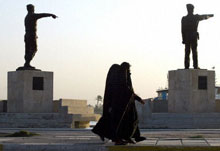
| Women return home at dusk in Basra, in southern Iraq (Photo: Karim Sahib/AFP). |
Though the United States seems more intent than ever on intervention in Iraq, its strategy is being resisted. France, Germany, Russia and China ask that U.N. weapons inspectors be given more time. This reflects the world's fear that a war would increase instability in the Middle East and provide terrorist networks with many recruits. In Baghdad the Iraqis are caught between the buildup of troops and the madness of the regime. David Baran reports from Baghdad. The Bush administration has failed to convince the Iraqi people of the morality or nobility of a war that it describes as a civilizing mission and an act of peace. But the Iraqis do now believe that the United States means business. Until recently they refused to take threats of war seriously because they were expecting only the latest in the series of crises since 1991, all of which actually seemed to strengthen the hand of Saddam Hussein (to the point that there were rumors that Baghdad and Washington might be in unholy alliance).
Iraq’s crises meant military strikes on key targets, with Iraqis reacting to attacks with indifference and resignation. In December 1998, Operation Desert Fox, the largest military operation in Iraq in the past 10 years, lasted four days but caused only a little panic buying. The first bombs fell by night, and the next morning students returned to schools and universities; absentees were penalized. Families spent the next evening on their rooftops, watching the proceedings like a game, trying to guess where missiles might land. Iraqis describe Desert Fox as if it had been a holiday.
Iraqis now have an unaccustomed sense of dread. Things seem normal at first, but there are signs of tension. Business is at a standstill. People are not investing or buying anything but daily necessities. Car prices have fallen. The volatile dollar exchange rate has hit record lows despite the authorities’ vigorous efforts to control the fluctuations. The state of Iraq’s foreign currency markets has reflected and intensified a wider public awareness. Iraqis are tuning in to foreign broadcasts, in particular Radio Monte Carlo (in Arabic) and an Iranian Arabic satellite channel that has been recently approved. People now read imported magazines and pass them to their friends. Even those who say they are tired of the news spread rumors, revealing their awareness of events. Communications have multiplied so much and so quickly that fear, the binding force of Saddam Hussein’s regime, is gradually losing its grip.
There is now a certainty of change, less because of the warmongering tone of the United States than because the regime’s response makes it clear that time has run out: Saddam Hussein yielded to U.S. pressure when he agreed to the unconditional return of inspectors from the U.N. monitoring, verification, and inspection commission (UNMOVIC). His subsequent offer to allow CIA agents to work alongside the inspectors was regarded by some as treason. He granted unfettered access to restricted military sites as well as to his own palaces—a source of friction with the previous inspectors from the U.N. Special Commission (UNSCOM) in 1998. He apologized to the people of Kuwait more than 12 years after the Iraqi invasion; Iraqis view this belated act of contrition as a sign of weakness and cowardice. It is rumored that Saddam Hussein is also making oil deals in an attempt to remain in control. So he appears willing to do anything to hold on to power, even if this means sacrificing Iraq and the dignity of the people.
But this new certainty is fragile. Iraqis describe current events as a play in which they are just the spectators, with the real drama behind the scenes. The true motives for Bush’s war seem to have little to do with weapons of mass destruction or the fate of the Iraqi people.
The Bush administration has failed to present any credible plan for Iraq’s future. Yet the Iraqi opposition, plagued by internal feuding and with no base of popular support, continues to discuss post-Saddam scenarios exclusively with the United States. The opposition’s subversive radio broadcasts are considered as unreliable as the official media because they use the same propaganda, disinformation, and rhetoric. The Iraqi people have no crystal ball, though they know that coming events will be critical. They will have to face the profound consequences of war.
They need to debate, analyze, and conjecture. Their unquenchable thirst for meaning, together with the lack of any coherent, structured message that might satisfy it, has led to horrible fantasies. Iraqis believe the Americans want not to liberate them but to invade and humiliate them. They imagine having to show their papers to U.S. soldiers on every street corner, they imagine triumphant, arrogant marines wearing shorts and sipping beer, chatting up girls and taking advantage of the nation’s poverty.
Iraqis seek underlying reasons for their plight and attempt to identify the evil forces that have produced such injustice and cruelty. The regime’s main argument takes a hackneyed pan-Arab worldview denouncing U.S. imperialists for seeking dominance over Arab nations in order to wrest long-term control of their natural resources. (As usual, this is connected with a Zionist conspiracy theory.) Any concordance of official dogma and popular fiction should be seen for what it really is. Iraqis see Saddam Hussein, who proclaims himself champion of the fight against the United States and Israel, more as the agent of those countries. So despite the show of the build-up of troops, Iraqis think that war will be averted at the last minute by a secret, amicable deal.
The ambiguous information and the ambivalent feelings mean that Iraqis often hold contradictory beliefs. The fragmentation of Iraqi discourse extends to the war. Most Iraqis favor change, but the prevailing uncertainty fosters the here-and-now rather than any leap into the unknown. Will the war be short, or will there be months of hardship? Is it best to remain in Baghdad or seek refuge in the provinces? Will Saddam Hussein use non-conventional weapons against his own people? If he used poison gas and blamed the U.S. invaders for it, this would make good propaganda for the regime, and it would arouse strong feelings among the people.
The questions amount to this: Iraqis believe that the regime will eventually fall, and that is good, but at what cost? Does anyone believe that a better future will come from a war fought for private gain? The end of the regime will leave a power vacuum, and the race will be on to fill it. Any advances towards democracy will be risky. More importantly, when the tight network of the Ba’ath party, the police, and national security apparatus unravels, what will check the frustrations and resentments of poor, humiliated Iraqis? In 1991 there were widespread uprisings after Operation Desert Storm. Although these were called an Iraqi
intifada, they were mostly wanton destruction and settling of scores.
Many of the regime’s officials, from members of local Ba’ath party cells to senior intelligence officers, fear reprisals and are worried about their safety. Since any hint of disloyalty can be fatal in Iraq, these people cannot abandon their posts. This leaves them vulnerable to their victims, who may return seeking revenge. Some have tried to reconcile those whom they have humiliated, explaining that they disagreed with the orders they were obliged to carry out. Others have chosen the more radical option of moving. If war breaks out, they will follow orders, if unenthusiastically. This will avoid lengthening their list of enemies and cover the remote possibility that Saddam Hussein will survive. These are the preliminary moves in a game of repositioning that will be highly explosive once the regime falls.
The structured tribal system will complicate matters post-Saddam Hussein, when the cards will be dealt anew. The tribes, led by influential social and political figures, are known for their ability to mobilize their troops whenever group interests and honor are at stake. Their large arsenals include Kalashnikovs, grenades, and mortar shells, and they will get more supplies when the security apparatus collapses. They have broad social autonomy and apply tribal law in many legal matters. Complex intertribal conflicts will break out as they attempt to carve up land, water, and weapons while vying to boost their prestige and influence. There will be clashes between the tribes and the new central government; these may well degenerate into armed struggles.
Unlike their Afghan counterparts, Iraq’s tribes will be of no military use to the United States. With no reason to criticize Saddam Hussein’s policies, the strongest tribes will be well-positioned in any negotiations with the future administration. They have nothing to gain by betraying Saddam Hussein and everything to lose if he survives (and he has survived many assassination attempts, coups, and the Gulf war, in which 33 countries were against him). In all likelihood the tribes will seek to maintain their strategic positions as they wait for him to fall.
The most likely scenario is a brief period of instability. During the initial U.S.-led operations, Iraq’s security apparatus and forces will cautiously perform their duties. Rebellious residents of Baghdad slums and cities in southern Iraq will keep quiet, waiting for the opportunity to pounce. Then the end will come: The regime will crumble amid brutal violence as people take flight in the confusion. Any subsequent uprisings, looting, or lynching will be irrelevant to the war effort. Iraqis’ opinions vary about the regime’s ability to hold on, but everyone agrees chaos is imminent.
Although Washington discounts it, the prospect of instability figures prominently in the regime’s war plans. Saddam Hussein’s goal will be to prevent or delay social upheaval by keeping the population in line as long as he can. Contrary to extravagant official pronouncements urging the people to rise up
en masse to fight the invader, the regime is ensuring that Iraqis stay in their homes, with an around-the-clock curfew to be imposed as soon as hostilities commence. Iraqis have enough food rations to last until June. Televised warnings have discouraged families from selling rations as they usually do since they may need them soon. Workers have dug wells to provide drinking water in Baghdad and in provincial cities; this network is overseen by the Ba’ath party.
The party’s neighborhood units have already vacated their offices, regarded as potential targets, and set up headquarters in schools. Their tasks will include distributing water and methylated spirits used for lighting, heating, and cooking. Party officials assigned to each neighborhood will maintain public order, with each household held responsible for the conduct of its members, all of whom will be confined to their homes. Sandbags are already stacked up at main intersections for stringent traffic control.
In subtle ways these activities explain the official mindset; most officials would desert immediately if sent to the front to face the United States’ hi-tech military. According to anxious rumors, the United States has tanks capable of firing missiles as fast as bullets, planes that travel at 25 times the speed of sound, and missiles that can stop in mid-air to detect the slightest movement below. Safe in their headquarters, Saddam Hussein’s agents will be better at maintaining order, a task they can do with gusto. They are currently being trained to supervise street-by-street fighting, with the Republican Guard and Saddam Hussein’s Fedayin in charge of the sessions [founded by Saddam Hussein’s son Uday, this handpicked militia is made up of poor, young volunteers]. Some people are already equipped with Kalashnikovs, and the authorities will almost certainly distribute their stocks of small arms before the conflict.
Saddam Hussein’s overriding goal is to maintain his grip. In the cities, where the threat of uprisings is acute, Saddam Hussein is casting in his lot with the Ba’ath party and the national security apparatus, although he is well aware that their loyalty is fragile. Despite its threats of reprisals, the regime does not require its representatives to make untenable commitments or sacrifice themselves; it merely expects them to perform their regular duties. This doctrine of strict-but-minimal engagement also applies to rural areas, where the allied tribes will not be asked to fight unless they have to. Preventing uprisings and foreign infiltration of tribal lands will be their job, and they have been paid and armed with this in mind.
Saddam Hussein will try to play on the people’s deep apathy, which he takes for granted in peacetime. Spreading out the security personnel, to evacuate at the slightest alarm, strengthens the regime’s effectiveness and deterrent power. Clever propaganda should be enough to maintain fear and preclude rioting. Another key consideration is Saddam Hussein’s personal safety, ensured in conflict-proven ways. The emphasis is on mobile defensive procedures, including decoys, unmarked vehicles, and surprise stays with families forced to surrender their homes overnight; Saddam Hussein is also said to use various doubles. Lively rumors evoke his mysterious and wily ways as he seeks out hiding-places, including an underground network accessible though the huge mosques under construction in Baghdad.
The overwhelming U.S. firepower rules out any standard counterattack by Iraq, which only stands to gain from any confrontation that runs counter to U.S. plans. A prolonged war with many casualties on either side could trigger a counterreaction leading to a popular uprising against the invaders. The current U.S. plans, which work only if Saddam Hussein is quickly overthrown, are still seen as unjust and immoral; it is in the regime’s interests to make street-by-street fighting the focal point of war.
What will be the role of Iraq’s conventional combat units, the standing army and the Republican Guard? These are the only forces able to challenge U.S. firepower, although Saddam Hussein undoubtedly has little faith in his troops’ loyalty or military capabilities. One strategy could solve this: requiring his soldiers to remain at their posts as they carry out their minimal duties. Stationed outside Baghdad, Saddam Hussein’s regular troops will offer only token resistance to any U.S. bombing campaign or military invasion, allowing the United States a foothold in the center of the country. Iraq’s elite reserves might then step in; these are woven into the fabric of city life and will be elusive targets for a bombing campaign. Besides the troops sent to slaughter on the front lines, the regime will establish multiple combat zones. If Saddam Hussein is still in power after popular uprisings, the regime will attempt the counterreaction scenario. The high probability that the regime will fall does not preclude the possibility that that the Iraqis will rise up in violent opposition to the U.S. military presence, though few Iraqis will take up arms in defense of the regime. But weapons are within reach for many who say they are ready to kill soldiers from any occupation force.
All this seems to favor radicalism. The Iraqi regime and U.N. sanctions have brought years of hardship and humiliation. Tensions are at boiling point. Yet the swift establishment of democracy and peace in Iraq is theoretical. In reality Iraqis may be receptive to new arguments, but simplistic, dogmatic forms of debate, using warmongers’ words, are often the most persuasive. Even though the Iraqis are the targets in all this, they are strangely missing from the debate. Some Iraqis have made up their minds: If there is no war, they will leave Iraq, since another decade of Saddam would be too much to bear. Others, if forced to choose, would opt for a president who is satisfied with his lot rather than a power-hungry successor who might gobble up the nation. Do any Iraqis hope that the United States will assume full responsibility for Iraq's future, bringing peace and prosperity and a new Marshall plan? No.

