Africa

Commentary
Will NEPAD Prove Another False Start for Africa?
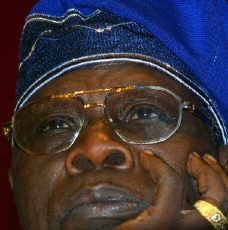 |
| Nigerian President Olusegun Obasanjo at the end of the NEPAD summit, May 17, 2002 (Photo: AFP). |
One of civil society’s gripes with the New Partnership for Africa’s Development (NEPAD), given a limited endorsement last week by the G-8 summit in Kananaskis, Canada, is that although NEPAD talks about “ownership” of the process by the African people and indeed exhorts the people to “mobilize themselves” behind it, they have not been consulted in the process.
After the presidents of South Africa, Nigeria, Senegal, and Algeria had discussed NEPAD among themselves, they appear to have gone first to Western capitals and representatives of international private capital before consulting their own people.
Presumably, the people will follow. But the mood in Africa is changing, and putting the donor countries and international private capital ahead of the people of Africa in the consultation process was not, to say the least, a wise strategy. It begs the famous question that René Dumont raised in the 1960s about Africa’s development: Is this yet another “false start”?
The path that NEPAD offers is the neo-liberal path that is espoused by the International Monetary Fund, the World Bank, and the World Trade Organization. Neo-liberalism puts “integration into the globalized economy”—meaning liberalization of markets and the free movement of capital—at the center of the development paradigm. But can an African renaissance really take place through further integration of Africa into an asymmetric globalized system that is dominated by a few countries?
The leaders of Africa do not seem to see any alternative. NEPAD appears to lean toward the creation of the “right” kind of conditions within Africa: good governance as understood by the Northern partners, greater access to their markets, partial measures on debt relief, and increased aid from the North. At one point, NEPAD does recognize that globalization “has increased the ability of the strong to advance their interests to the detriment of the weak,” but this is only a descriptive statement; it has no strategic or tactical significance.
Is there an alternative strategy to achieve the noble goals of “self-reliance” and “ownership” of the process of development?
The point to begin is with human needs, not further integration of Africa’s economy into the process of globalization. This is not a pedantic but a profoundly strategic difference. For example, the people of Soweto in South Africa need, among other things, access to drinkable water. There are two ways of going about it—the NEPAD way, and the people’s way.
In the NEPAD way, you open this essential service to international competition; whoever is able to bring in the capital from outside can have control over the distribution of water and must be able to charge “cost-recovery” prices. If people cannot pay, their water must be cut off until they are able to pay. In the process, the government of South Africa must create a climate of confidence (above all, the ability of the investor to externalize his profits and eventually the capital value of his assets) so that an investor is induced to come to South Africa rather than to, say, Vietnam or Chile or Romania.
The people’s way starts with the recognition that water is a basic human right. Its provision to all households in Soweto (our example) is the government’s responsibility that cannot be turned on or off on the basis of the people’s ability to pay. The same is true of food, adequate housing, electricity, basic education, and essential transport. Subject these to the whims of profit, and you have subverted the human rights of the people.
NEPAD admits that structural adjustment programs (SAPs) [imposed by the IMF and the World Bank] paid “inadequate attention to the provision of social services.” African governments knew, in advance, that SAPs would lead to the diminishing of social services. The IMF was adamant in its demand that, in return for its money, it expected governments to cut down on budget deficits, which meant, in practical terms, expenses for things like health and education. Governments were then advised to set aside a “social fund” to cushion the effects of SAPs.
In none of the countries in Africa that accepted SAPs did the social fund prove adequate to fill the gap that the SAPs created. NEPAD’s solution is to place these services in the globalization basket and let private capital (foreign, as it would mostly turn out) finance them. For this to happen, African countries must attract foreign direct investment (FDI). Thus, services would occupy a central place for investment on a competitive basis.
This is not only a pipe dream (such investments are not likely to materialize), but also a dangerous one. In trying to attract foreign capital for essential services, African governments are going to be dragged into a downward spiral of offering to the owners of capital competitive terms, including tax incentives or tax holidays, free land, borrowing in local currency, and so on.
The road to hell is paved with good intentions. The practical effect of NEPAD would be to surrender the human rights of the people of Africa (their rights to food, water, energy) to the whims of a volatile and untrustworthy global capital. If the experience of Argentina does not give us pause, Africa will have to learn, bitterly, from its own experiences.